Building an Offline-First Car Maintenance Tracker MVP with React Native & Expo
Introduction
Vehicle maintenance is predictable — yet easy to neglect. Oil changes, insurance renewals, inspections, fuel costs, and unexpected repairs quickly become fragmented across notes, receipts, and memory.
To solve this, we built Car Maintenance Tracker: an offline-first mobile MVP designed to centralize vehicle data, simplify logging, and provide clear spending insights — all without requiring an internet connection.
This article walks through the feature set, architectural decisions, and the technical foundation behind the app.
🚗 Core Features
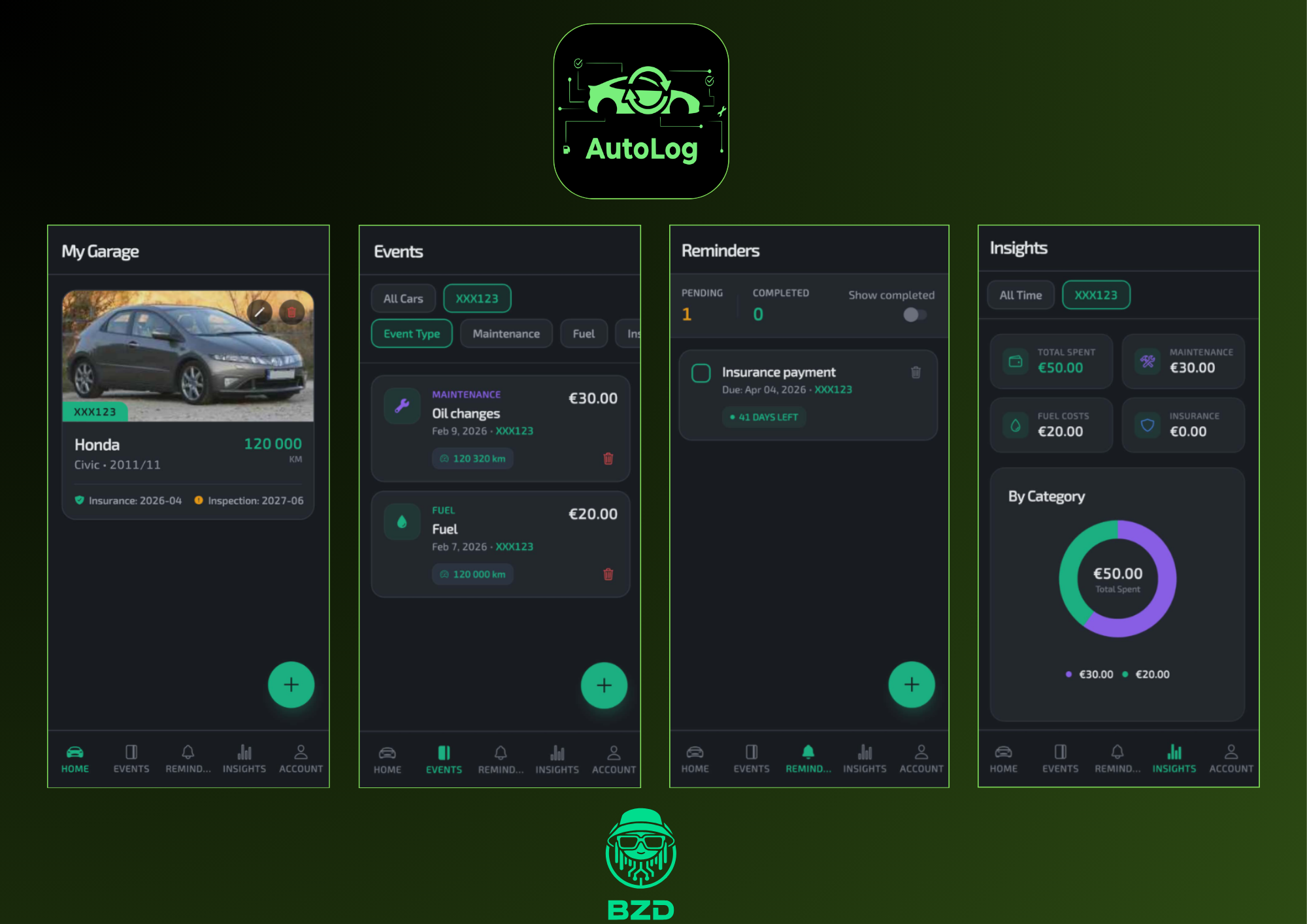
Multi-Vehicle Management
Each vehicle profile stores structured, comprehensive data:
- Plate number, brand, model, year
- Fuel type (petrol, diesel, electric, hybrid, LPG)
- Odometer with km/mi support
- Insurance & inspection expiry dates
- Photo capture with compression
The detail screen combines a visual hero section with timeline-based event history and quick statistics for immediate context.
Event Logging System
The app supports four event categories:
- Maintenance (repairs, servicing, parts)
- Fuel
- Insurance
- Custom
Each event includes:
- Title and amount (auto-adjusted to selected currency)
- Date picker integration
- Mileage validation against current odometer
- Optional comments
Filtering by vehicle and category ensures fast access to relevant history.
Smart Reminder Engine
To prevent missed deadlines:
- Dual-date system (due date + reminder date)
- Recurring reminders with automatic regeneration
- Completion tracking with next-cycle creation
- Dashboard counters for pending vs. completed items
Recurring inspections and annual renewals are handled automatically.
Analytics Dashboard
Spending visualization is powered by react-native-gifted-charts:
- Donut chart by category
- 6-month animated trend bars
- Total, monthly average, and per-event metrics
- Per-vehicle filtering
The goal: actionable financial clarity at a glance.
Internationalization & Preferences
Designed for international use:
- English & Hungarian via
react-i18next - USD / EUR / HUF currency support
- Kilometer / Mile unit toggle
All preferences persist locally and update instantly.
🏗️ Architecture & Technical Decisions
Technology Stack
| Layer | Technology |
|---|---|
| Framework | React Native 0.81 + Expo 54 |
| Navigation | Expo Router (file-based tabs) |
| Language | TypeScript 5.9 |
| Storage | AsyncStorage |
| Charts | react-native-gifted-charts |
| Dates | date-fns |
| i18n | react-i18next |
1️⃣ Offline-First with Migration Path
The app is structured around a DataService abstraction:
LocalClient→ AsyncStorage implementationRemoteClient→ HTTP-ready backend placeholder
Switching from local-only to cloud sync requires minimal changes.
The UI remains untouched.
This enables:
- Fully offline functionality today
- Seamless backend integration tomorrow
2️⃣ Strong Type Safety
All domain entities (Car, CarEvent, Reminder, Preferences) are strictly typed.
This guarantees:
- Data consistency
- Safer refactoring
- Clear contracts between layers
- Reduced runtime errors
Strict TypeScript significantly improves long-term maintainability.
3️⃣ Separation of Concerns
The project structure enforces clean boundaries:
- Presentation layer → Expo Router screens
- Business logic → DataService
- Persistence layer → API clients
- Global state → Context providers
- Reusable UI → Shared components
The result is modular, testable, and extensible.
4️⃣ Business Logic Centralization
Smart behavior (e.g., mileage auto-update when logging fuel or maintenance) lives inside DataService, not in UI components.
This prevents duplication and keeps screens declarative.
5️⃣ Reusable Component Patterns
Common UX patterns are abstracted into shared components:
- Empty state layouts
- Card-based list items
- Modal form patterns
- Validation handling
Consistency improves both development speed and UX coherence.
📊 Implementation Highlights
Image Optimization
Vehicle photos are resized and compressed before being stored as base64 to reduce memory footprint while maintaining visual quality.
Mileage Integrity Validation
Events cannot reduce a vehicle’s recorded mileage, protecting historical accuracy.
Recurring Reminder Automation
When a recurring reminder is completed, the next cycle is generated automatically — no user action required.
🚀 Roadmap
Phase 2 — Cloud & Sync
- User authentication (Firebase / Supabase)
- Multi-device synchronization
- Export to PDF / CSV
- Shared vehicle access
Phase 3 — Intelligence
- Push notifications
- OCR receipt scanning
- Fuel efficiency tracking
- Predictive maintenance suggestions
Phase 4 — Ecosystem Integration
- Garage booking integrations
- Parts marketplace connectivity
- Insurance API sync
- Fuel price comparison
✅ Conclusion
This MVP demonstrates how a well-architected React Native application can deliver a polished, offline-first experience while remaining fully scalable.
Key strengths:
- Offline-first by design
- Clear abstraction layers
- Strict TypeScript typing
- Clean separation of responsibilities
- Ready-to-scale architecture
The foundation is production-ready, extensible, and future-proof.
Built with React Native, Expo, and TypeScript — engineered for the long road ahead.